Generative AI is transforming customer service from a reactive cost center into a proactive, value-creating engine. By leveraging generative AI in customer service, businesses can deliver faster responses, higher satisfaction, reduced costs, and happier agents, all while unlocking new insights about what customers really need. Organizations are exploring a variety of use cases: AI in call centers for businesses and adopting Generative AI Call Center Solutions for Agent Productivity to modernize operations and empower support teams.
This guide explains what generative AI in customer service actually is, why it matters now, and how organizations can use it to build a modern, scalable, and delightfully efficient support operation.
Modern businesses are increasingly relying on advanced computing resources to enhance AI-driven customer experiences. Platforms like FlashMob Computing - scalable AI-driven customer solutions provide infrastructure that supports real-time AI interactions, making it easier for companies to respond to customer needs without delay. When paired with high-performance systems from Supercomputer Box high-speed processing for AI applications, organizations can handle massive volumes of customer data, ensuring that insights generated through AI are both accurate and actionable.
Marketing teams are also taking notice of these AI capabilities. Resources like Marketing for Customers AI-powered engagement strategies help businesses integrate AI insights into customer campaigns, improving personalization and boosting satisfaction rates. Similarly, companies exploring Marketing Runners advanced AI-driven marketing solutions can streamline operations and deliver consistent experiences across all channels.
Financial planning and customer service performance go hand-in-hand, especially when AI tools help organizations optimize resource allocation. Trusted sites like Top Financial Resources - AI-enabled business planning offer guidance on leveraging AI insights to manage costs effectively while maximizing productivity. By connecting AI-driven analytics with operational strategy, businesses can make smarter decisions that positively impact both customer experience and profitability.
As generative AI in customer service continues to evolve, companies adopting these solutions are finding that they can offer more proactive support, identify pain points before they escalate, and empower agents to focus on higher-value tasks. From integrating AI into call center workflows to using predictive analytics for personalized service, the possibilities are expanding rapidly, enabling businesses to stay competitive and customer-focused.
Top 10 Contact Center Solutions Transforming Customer Service with AI
Generative AI is revolutionizing the way businesses handle customer interactions, enabling faster response times, smarter analytics, and more efficient operations. Here’s a look at the top 10 contact center solutions leveraging AI to deliver exceptional customer experiences.
1. Bright Pattern – AI Contact Center Call Center Solutions
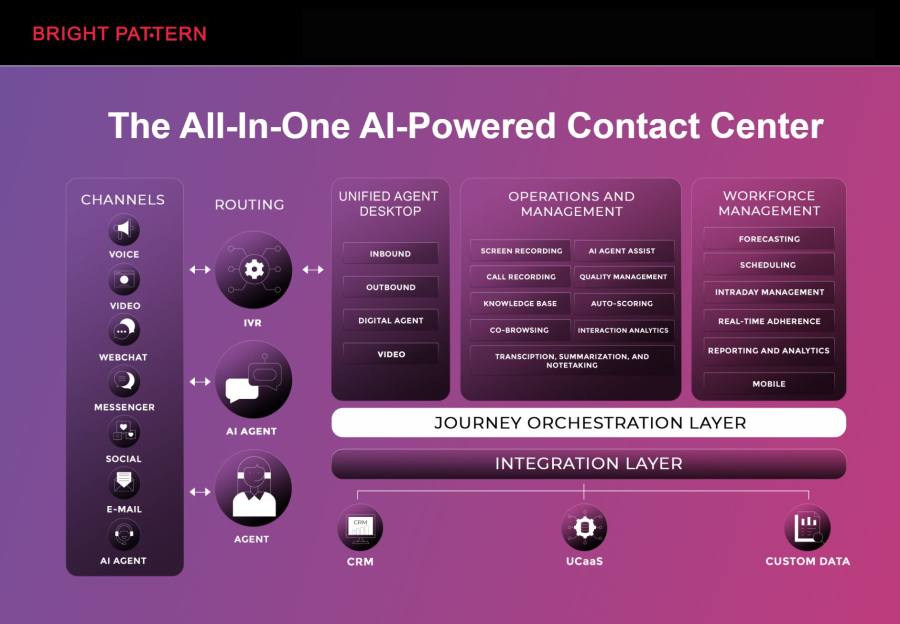
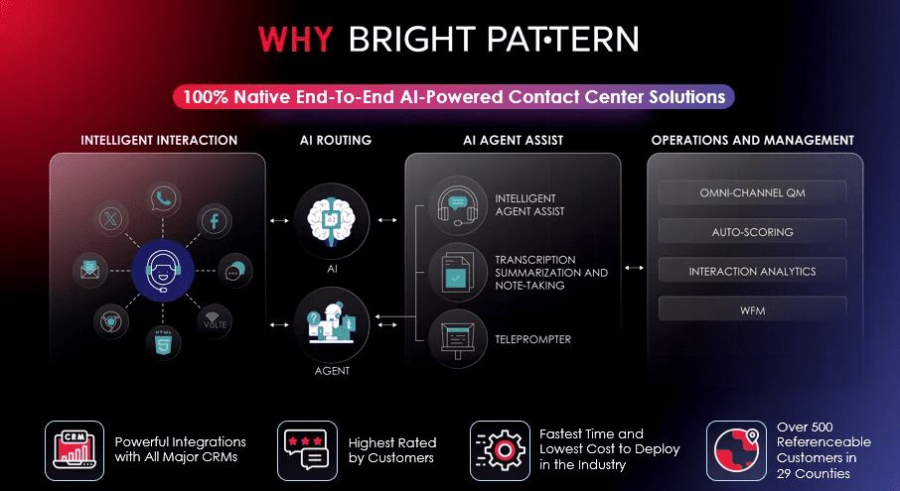
Bright Pattern leads the industry in providing AI-powered contact center solutions that help organizations improve customer engagement and agent productivity. By integrating generative AI in customer service workflows, Bright Pattern enables companies to deliver personalized, proactive, and scalable support.
Key features include:
- AI-assisted agent workflows for faster problem resolution
- Omnichannel support across voice, chat, email, and social media
- Advanced analytics to uncover customer insights and trends
- Intelligent routing to connect customers with the right agent quickly
- Integration with CRM systems and third-party applications
Bright Pattern’s AI contact center call center solutions make it easier for businesses to implement automated yet human-centered support processes while maintaining high customer satisfaction.
2. Genesys Cloud
Genesys Cloud offers AI-driven contact center software that focuses on predictive routing and automation. It helps teams manage interactions efficiently across multiple channels and provides analytics to optimize operations.
3. Five9 Intelligent Cloud Contact Center
Five9 provides cloud-based solutions with AI features like predictive dialers, sentiment analysis, and real-time agent assistance. The platform is designed to reduce wait times and increase first-call resolution rates.
4. NICE CXone
NICE CXone combines AI and analytics to improve customer engagement. Its features include conversational AI, workforce optimization, and performance management tools for more efficient call center operations.
5. Talkdesk CX Cloud
Talkdesk CX Cloud leverages AI to streamline workflows, automate repetitive tasks, and provide agents with actionable insights. Its focus on enhancing agent productivity makes it ideal for modern contact centers.
6. Cisco Webex Contact Center
Cisco Webex integrates AI-driven tools for proactive support, predictive analytics, and omnichannel customer engagement. It emphasizes security, scalability, and seamless integration with enterprise systems.
7. Amazon Connect
Amazon Connect uses AI services from AWS to deliver intelligent call routing, real-time transcription, and automated self-service options. The platform is flexible and scalable for businesses of all sizes.
8. 8x8 Contact Center
8x8 Contact Center offers AI-powered analytics and voicebots that support automated interactions, reducing agent workload and improving response times. Its unified platform integrates communication and contact center solutions.
9. RingCentral Contact Center
RingCentral provides cloud contact center solutions with AI-enabled automation, sentiment analysis, and workforce optimization. It helps organizations deliver more efficient, data-driven customer service.
10. Avaya OneCloud CCaaS
Avaya OneCloud CCaaS combines AI, analytics, and multichannel support to enhance customer experiences. It offers real-time insights, intelligent routing, and self-service options for modern contact centers.
What Is Generative AI in Customer Service?
Generative AIis a type of artificial intelligence that can create new content based on patterns it learns from data. In customer service, it can generate useful responses, summaries, drafts, suggestions, and even workflows that help both customers and agents.
Unlike traditional rule-based chatbots that rely on predefined scripts and rigid flows, generative AI can understand natural language questions and produce context-aware answers in real time. It can adapt to the way people actually speak and type, not just to a fixed list of keywords.
In practical terms, generative AI in customer service can:
- Answer common questions instantly via chat or messaging.
- Draft empathetic and accurate replies for human agents to review.
- Summarize long conversations or tickets into key points.
- Surface relevant knowledge base articles for specific issues.
- Translate and localize support content across languages.
- Suggest next best actions based on customer history and context.
All of this happens in a way that can be tuned to match your company’s tone of voice, policies, and brand personality.
Why Generative AI Is a Game Changer for Customer Service
Customer service teams are under pressure from all sides: rising customer expectations, complex products, staffing constraints, and the need to operate across multiple channels and time zones. Generative AI addresses these challenges in ways that traditional tools cannot.
From Static Scripts to Dynamic Conversations
Older chatbots often failed because they could only handle narrow, scripted scenarios. Customers quickly hit dead ends and escalations. Generative AI changes that by understanding intent and generating responses on the fly, leading to more natural, helpful interactions.
From Tickets to Relationships
Customer service is no longer just about closing tickets. It is about building loyalty and long term relationships. By enabling faster, more personalized, and more consistent service, generative AI helps turn every interaction into an opportunity to strengthen trust.
From Cost Center to Strategic Asset
Support has long been viewed as a cost to be managed. With generative AI, every conversation becomes a source of insight. Summaries, trend detection, and conversational analytics can feed into product, marketing, and strategy teams, turning support into a strategic information hub.
Key Benefits of Generative AI in Customer Service
When thoughtfully deployed, generative AI delivers measurable benefits across speed, quality, cost, and employee experience.
1. Faster Responses and Reduced Wait Times
Generative AI can provide instant responses to many customer questions, which dramatically reduces queue times and first response times. Even when a human agent is involved, AI can draft replies or surface relevant information in seconds instead of minutes.
Typical improvements organizations see include:
- Lower average response time across email, chat, and messaging channels.
- Shorter average handle time because agents spend less time searching for answers.
- Higher first contact resolution when the right information appears at the right moment.
2. 24 / 7 Support Without 24 / 7 Staffing
Customers expect help whenever they need it, not just during business hours. With generative AI powered virtual agents, you can offer continuous support without building a large overnight or weekend team.
This does not replace your human experts. Instead, AI handles routine and repetitive requests, escalates complex or sensitive issues to people, and ensures customers always have a first line of assistance available.
3. Personalized, Context Aware Experiences
Generative AI can adapt responses based on past interactions, preferences, and account data. For example, it can:
- Recognize returning customers and continue the conversation where it left off.
- Adjust language and tone based on customer profile and channel.
- Offer tailored recommendations or troubleshooting steps for a specific product setup.
This level of personalization helps customers feel known and valued, which is a key driver of satisfaction and loyalty.
4. Happier, More Productive Agents
Generative AI is often described as acopilot for agents. Instead of replacing them, it gives them powerful support so they can focus on higher value work. Common benefits include:
- Automatic drafting of responses that agents can quickly review and send.
- Instant summaries of long email threads or previous chats.
- Suggested replies that follow current policies and brand guidelines.
- Reduced manual note taking and after call documentation.
The result is less burnout, more time for complex cases, and a better overall employee experience. Agents can spend more time using their judgment, empathy, and problem solving skills instead of copying and pasting or searching through multiple tools.
5. Consistent Quality Across Channels and Regions
Maintaining consistent quality in large, distributed support teams is challenging. Generative AI can help standardize responses so that customers receive clear, accurate, and brand aligned answers regardless of the channel or location.
For global operations, AI based translation and localization can deliver better multilingual support without requiring fluent speakers for every language and shift.
6. Scalable Support During Spikes and Launches
Seasonal peaks, product launches, promotions, or unexpected events can cause ticket volumes to surge. Generative AI based assistants scale instantly. They can absorb a large portion of the increased volume while routing complex issues to human teams in a structured way.
This protects customer experience even during high demand periods and reduces the need for emergency hiring or overtime.
High Impact Use Cases for Generative AI in Customer Service
Generative AI can touch nearly every stage of the service journey. Below are some of the most impactful and widely adopted use cases.
1. AI Assisted Chat and Messaging
In live chat, messaging apps, and in app support, generative AI can act as the first line of response. Typical capabilities include:
- Answering FAQs and how to questions using information from your knowledge base.
- Collecting relevant information upfront before handing off to humans.
- Guiding customers through simple workflows such as password resets or order status checks.
- Escalating to agents with a clear summary and context, reducing repetition for the customer.
2. AI Drafted Email and Ticket Responses
For email based support and ticketing systems, generative AI can read the customer message, identify intent, and propose a full response based on your knowledge articles and past successful resolutions.
Agents can then:
- Review, edit, and send the draft in a fraction of the time.
- Ensure tone, disclaimers, and policies are all automatically applied.
- Maintain high quality even when dealing with large backlogs or time pressure.
3. Agent Assist and Knowledge Suggestions
While an agent is chatting or on a call, generative AI can listen to the conversation (through text) and suggest:
- Relevant knowledge base articles.
- Recommended troubleshooting steps.
- Offer details, pricing, or eligibility information.
- Regulatory or compliance language where required.
By surfacing the right information at the right time, AI reduces the need for agents to search multiple systems, which shortens handle time and boosts confidence.
4. Automatic Summaries and Case Notes
After a call, chat, or long email thread, agents usually need to write up notes and summarize the interaction. Generative AI can automatically generate concise summaries that capture:
- The main customer issue.
- Steps taken to resolve it.
- Any follow up actions or commitments.
- Sentiment or level of urgency.
This improves documentation quality, saves agent time, and creates better data for analytics and future reference.
5. Self Service Knowledge and Help Center Optimization
Generative AI can make your existing knowledge more powerful by:
- Converting technical documentation into customer friendly explanations.
- Generating draft help articles based on recurring questions in tickets.
- Rewriting and organizing content to be clearer and easier to find.
- Providing conversational answers on top of your existing knowledge base.
Over time, this creates a richer, more accessible self service experience that deflects tickets and empowers customers to help themselves.
6. Multilingual Support at Scale
Generative AI models with translation and language capabilities can enable support in multiple languages without fully separate teams. They can:
- Translate customer inquiries into the agent’s primary language.
- Help draft responses and then localize them back to the customer’s language.
- Maintain consistent style and terminology across markets.
This opens the door to expanded global service coverage with lower incremental cost.
How Generative AI Compares to Traditional Customer Service Tools
Generative AI does not replace your existing customer service stack; it enhances it. However, its capabilities differ significantly from older, rules based approaches.
|
Aspect |
Traditional Tools |
With Generative AI |
|
Interaction style |
Scripted flows, fixed responses. |
Natural language conversations, dynamic responses. |
|
Coverage |
Limited to predefined scenarios. |
Handles a wide range of questions and variations. |
|
Maintenance |
Frequent manual updates to flows and rules. |
Updates by improving knowledge sources and prompts. |
|
Agent support |
Static templates and articles. |
Real time suggestions, drafts, and summaries. |
|
Customer experience |
Rigid, sometimes frustrating. |
More human like, responsive, and personalized. |
Designing a Generative AI Strategy for Customer Service
To unlock the full benefits of generative AI, it is important to approach it as a strategic capability, not a quick fix. The most successful organizations follow a structured approach.
1. Clarify Your Objectives
Start by deciding what success looks like. Common objectives include:
- Reducing average handling time or backlog.
- Increasing self service resolution rate.
- Improving customer satisfaction or net promoter scores.
- Enhancing agent productivity and reducing burnout.
- Expanding support hours or languages cost effectively.
Clear goals help you prioritize use cases and measure progress in a meaningful way.
2. Map Your Customer Journeys and Pain Points
Examine where customers struggle most today. For example:
- Are there recurring questions that flood your inbox?
- Do customers abandon chat sessions due to long waits?
- Are agents spending too much time on documentation or research?
- Is multilingual coverage inconsistent across regions or channels?
Use this insight to identify high impact starting points for generative AI, such as FAQ chat, email draft assistance, or case summarization.
3. Prepare and Organize Your Knowledge
Generative AI is powerful, but it is only as good as the information it can access. Invest in:
- Up to date knowledge base articles.
- Clear internal documentation and playbooks.
- Well defined policies, terms, and conditions.
Structuring and maintaining your knowledge sources helps AI provide accurate, consistent responses and reduces the need for manual corrections.
4. Start with Pilot Projects
Instead of trying to transform everything at once, focus on one or two pilots where you can deliver quick but meaningful wins. Examples include:
- AI drafted replies for a specific category of tickets.
- An AI assistant that supports agents during live chat sessions.
- A self service chatbot for a well defined product or feature.
Measure the impact, gather feedback from customers and agents, and refine your approach based on what you learn.
5. Involve Your Agents Early and Often
Your support teams are critical to success. They understand customer needs and edge cases better than anyone. Involving them early helps you:
- Design prompts and workflows that match real world scenarios.
- Spot gaps or risks before they reach customers.
- Build trust and excitement instead of resistance.
Position generative AI as a tool that amplifies their skills and reduces repetitive work, not as a replacement. Show them how it will make their day to day tasks easier and more rewarding.
Best Practices for Implementing Generative AI in Customer Service
To get the most value and maintain a positive customer experience, consider the following best practices.
1. Keep Humans in the Loop
Even as automation increases, human oversight remains essential. Proven patterns include:
- AI drafts responses, agents approve and send.
- AI handles routine queries, escalates complex or sensitive ones.
- AI summarizes conversations, humans make key decisions.
This combination delivers both efficiency and quality, especially in industries where nuance and empathy are crucial.
2. Set Clear Boundaries and Guardrails
Design your AI to operate within defined boundaries. For example, you can:
- Restrict the topics it can address to your documented products and policies.
- Prevent it from making promises or commitments that require human approval.
- Ensure it provides options to contact a human when needed.
Well defined boundaries help maintain trust and reduce the risk of inaccurate or inappropriate responses.
3. Continuously Train and Improve
Generative AI improves over time when you feed it better data and feedback. Build a loop where you:
- Review sample conversations regularly.
- Update prompts and instructions to guide its tone and behavior.
- Refine knowledge sources based on gaps or misunderstandings.
- Incorporate agent and customer feedback into future iterations.
This ongoing tuning helps your AI stay aligned with product changes, new policies, and evolving customer expectations.
4. Communicate Transparently with Customers
Customers appreciate honesty. Let them know when they are interacting with an AI assistant and when a human is stepping in. Clear communication builds confidence and sets expectations around response speed and capabilities.
5. Monitor Key Metrics and Customer Sentiment
Track both efficiency and experience metrics, such as:
- First response time.
- Resolution time.
- Self service resolution rate.
- Customer satisfaction and sentiment scores.
- Agent productivity and satisfaction.
Look for trends over time and compare performance before and after AI implementation. This data will help you demonstrate value and secure support for further investment.
Measuring the Impact of Generative AI in Customer Service
To turn generative AI into a long term advantage, you need a clear view of its impact. Many organizations focus on a blend of operational and experiential metrics.
Operational Metrics
- Average handle timefor tickets and calls.
- Queue lengthand backlog over time.
- Deflection ratefrom human to self service channels.
- First contact resolutionpercentage.
- Volume per agentand case throughput.
Customer Experience Metrics
- Customer satisfactionscores after interactions.
- Net promoter scoretrends.
- Customer effort scorein self service flows.
- Qualitative feedbackfrom surveys and reviews.
Agent Experience and Business Outcomes
- Agent satisfactionand engagement scores.
- Training timefor new agents using AI assisted tools.
- Escalation ratesfor complex issues.
- Revenue impactfrom improved retention or upsell during service interactions.
By tying generative AI initiatives to these metrics, you can clearly demonstrate how they contribute to both cost efficiency and revenue growth.
The Future of Generative AI in Customer Service
Generative AI is evolving rapidly, and customer service is one of the spaces where innovation will continue to accelerate. Looking ahead, organizations can expect:
- Even smarter routing and triagethat matches customers with the right agent or AI instantly.
- Deeper integrationwith CRM and product data, enabling more personalized and proactive support.
- Proactive outreachto prevent issues before customers feel the impact.
- Richer analyticsthat transform conversations into actionable insights for product and strategy teams.
- Unified AI assistanceacross sales, support, and success, ensuring a seamless customer journey.
Organizations that start building their generative AI capabilities today will be well positioned to take advantage of these advances and stay ahead of rising customer expectations.
Bringing It All Together
Generative AI in customer service is more than a new technology trend. It is a powerful way to redesign how you serve customers, support your teams, and grow your business.
By focusing on clear objectives, high impact use cases, and a human centric approach, you can:
- Deliver faster, more accurate, and more personalized support.
- Empower agents with tools that reduce repetitive work and amplify their strengths.
- Scale cost effectively without sacrificing quality or empathy.
- Turn every interaction into a source of insight and competitive advantage.
Customer expectations will only continue to rise. Generative AI gives you the opportunity to not just keep pace, but to set a new standard for what exceptional customer service looks like.
